VON LINTEL GALLERY

Showing posts with label CATHERINE HOWE. Show all posts

Friday, April 3, 2015

CATHERINE HOWE — CONTINUED AND RECOMMENDED, APRIL 2015 | artscene.com


Painter Catherine Howe's new work experiments with different methods and materials, all of which are a testament to her unbridled enthusiasm for the medium. Two of the seven works exhibited, almost all of which are indebted to both the imagery and quiet mournfulness of Dutch still-life painting, are "Reverse Paintings," where swirling brushstrokes of blooms and vases in acrylic, marble dust, and oil-based ink are painted on the reverse side of polyester sheeting. The effect is soft and almost ghostly, more of a memory of a painting than a living, breathing one. Similarly, "Mica Painting (Geisha)" utilizes mica pigment suspended in acrylic resin to create a shimmering and pale surface upon which gesso floral forms droop and dance. Finally, there are three "Carborundum and Silver" paintings, created by scattering sparkling carborundum dust on undulating, mostly abstract shapes that Howe painted in a clear gel. Working with this essentially blind process, our heightened awareness of the elements of intuition, memory and automatism (one of the works ended up revealing cat and mouse forms, which she references in its title) lend gravitas to the eye-catching works (Von Lintel Gallery, Culver City).

Kristen Osborne-Bartucca

Read more @ artscene


Sunday, March 15, 2015

CATHERINE HOWE | Supreme Fiction | March 7 — April 18, 2015 - Opening Photos


CATHERINE HOWE | Supreme Fiction | March 7 — April 18, 2015


Von Lintel Gallery is pleased to present an exhibition of new paintings by New York artist, Catherine Howe. Supreme Fiction is the artist's third solo show with the gallery. 

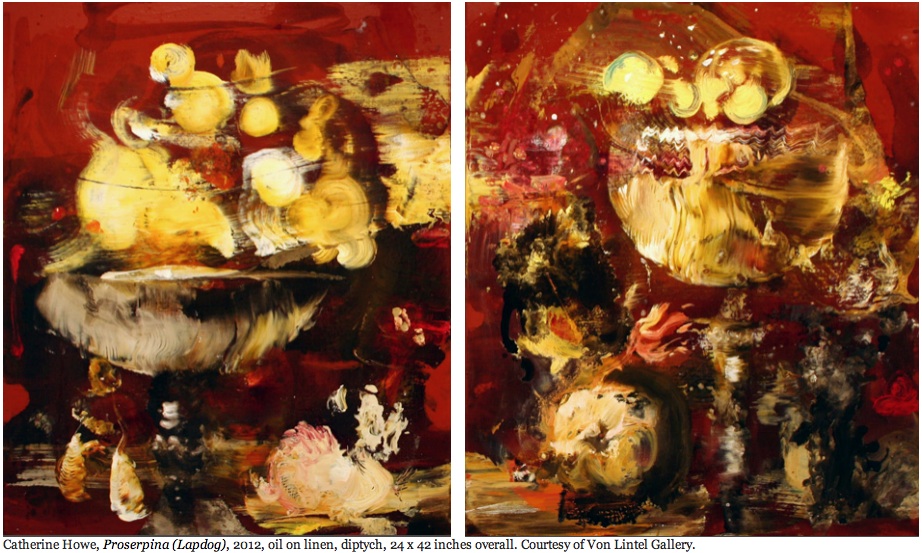
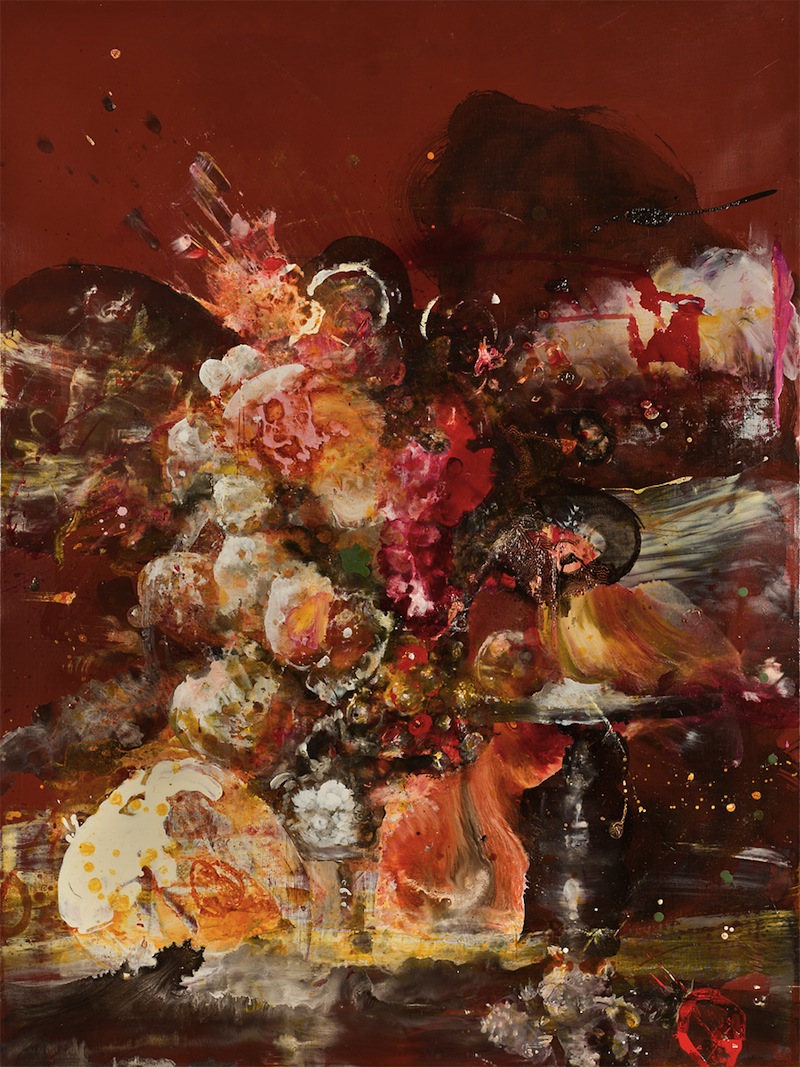
The unrestrained brushwork in Howe’s anarchic paintings inject raw emotion into docile subject matter, like flowers in a vase. By using the historical idiom of still-life as the anchor, Howe mashes the heroics of action-painting with the humility of vanitas tableaux.

Rather than focus on intimate observation, Howe operates on memory and feeling to invest mutable mediums with immense physicality. Pushing buckets of clear gloss over titanium molding paste, nascent forms become visible only after a dusting of carborundum grit (traditionally used to smooth lithography stone) and a final sweep of a broom. A self-proclaimed materials fiend, Howe also experiments with mica interference pigment suspended in acrylic resin to lend a refractive, iridescence to the canvas ground.

While the works explode with movement and texture, Howe restricts herself with respect to color. A stark palette emphasizes the expressive, psychological gestures seemingly unleashed during manic creative outputs. Howe qualifies the entire process as one of alchemy. As Michéle C. Cone writes in a recent catalogue essay, “Maybe, Howe’s evocative paintings are not about still life per se, but about the naming of things transposed into paint, and the magical interaction between medium, memory and perception.”

Born in Western New York in 1959, Howe received an MFA from SUNY Buffalo in 1983. The many publications that have reviewed her work include Art in America, Artforum, Art Critical, The New York Times, The New Yorker, and the Los Angeles Times. Howe has exhibited throughout the United States and Europe for over twenty years, including shows at the Corcoran Gallery of Art in Washington, DC, MoMA PS 1 in New York, and the Albright-Knox Art Gallery in Buffalo.
The exhibition is accompanied by an illustrated brochure with an essay by David Ebony.


Saturday, September 8, 2012

CATHERINE HOWE Featured on Huffington Post | Written by G. Roger Denson

Going Forward in Reverse: The Present Tense(ion) of History Painting (Banisadr, Howe, Dalwood, Steir, Taaffe, Quayola, Wang)

By G. Roger Denson | Cultural critic, essayist, novelist and screenwriter published with Parkett and Art in America


2012-09-07-4HoweFinal.jpg

In the last decade, the painters Ali Banisadr, Dexter Dalwood, Catherine Howe, Pat Steir, Phillip Taaffe, and Suling Wang, along with one exceptional digital animator from London named simply Quayola, have produced remarkably strong painting as a result ot their immersions in the history of painting and other cultural forms. Whether the artist is paintings a still life (Catherine Howe), a battle scene (Ali Banisadr), a landscape (Suling Wang), a hybrid of popular and art history (Dexter Dalwood), or digitally programming chance algorithms in the production of video paintings (Quayola), each of these painters is redefining the meaning of History Painting with a specific ideological intent. As for those painters who have used art history as a departure for their work for decades, (Pat Steir and Phillip Taaffe), they can be seen producing some of their most spectacular work today as derived from the remnants of art and cultural history. Whether or not the new emphasis on art history originated as a consciously-deployed Conceptualist-styled defense against the proscription of painting pronounced by artists and critics of the 1970s and 1980s is a subject of debate. But either way, the strategy of premising painting in art history seems to have proven successful in anchoring the painterly productions of at least the seven artists featured here.
[...]

Catherine Howe has produced her generation's most sumptuously inviting yet socially-decadent conflations made in the name of painterly reflection. For the last twenty years she has painted some variation of expressionist figuration, usually with readily-apparent allusions to art history. Her most recent work, shown last spring at the Thomas Von Lintel Gallery in New York, applies the notion of expressionist entropy to her own singular rephrasing of the epoch of still life paintings issued in 16th- and 17th-century Netherlands and Flanders, the most famous being categorized under the rubrics of vanitas and pronk painting.

Howe especially lingers over exquisite portrayals of beautiful objects, both man-made and organic, envisioned by the Dutch and Flemish masters to convey the transience of life on earth. In this respect Howe disregards the severe and blunt vanitas paintings of skulls and decay in favor of over-ripe and peeled fruit, liquors languishing in pristine glassware, and the blooms of flowers showing the first signs of their demise to come. But above such significations, Howe esteems "the moment" that will endure forever in art, and like the Dutch vanitas painters, instead of chosing to memorialize the peak of beauty, she captures the lingering evidence of the party that has just ended, yet is still felt by its revelers in the flush of night-long intoxications. The pronk still lifes are especially valued by Howe for their extravagantly-rendered, shimmering-to-the-point-of-ostentatious details, thereby inviting the lurid sensibilities of the contemporary expressionist painter to exploit their reinterpretation in an orgy of sensual overindulgence.

Howe's overindulgence in sensuality, however, is intended to seduce us into lingering long over the thought that both expressionism and vanitas-pronk paintings place emphasis on the immediacy of observed nature. She regards the visual hedonism unleashed in such paintings to be the sustaining grasp on what otherwise would be an ultimately uncontrollable and altogether vain pursuit of pleasure. In her re-enactment of the Dutch and Flemish sense of the visceral, she intuits that painting expressionistically allows her to visually sustain the feeling of being vitally alive, even if for only a moment. "Despite that I'm slipping away," she wrote to me in an email, "I have this acutely felt moment." Naturally, such a desire to prolong the ecstasy of painting would draw Howe to art history, considering that history prolongs our sense of the moment "slipping away from us." Of course, it can be claimed by some theories of time that "the moment" is never "really" slipping away as much as it is transforming, perpetually, as an eternal "moment" of the present. 

Read more @ Huffington Post

See more of Catherine Howe's work @ VON LINTEL GALLERY

Friday, April 6, 2012

CATHERINE HOWE | Art in America Review: The Lookout: A Weekly Guide to Shows You Won't Want to Miss


With an ever-growing number of galleries scattered around New York, it's easy to feel overwhelmed. Where to begin? Here at A.i.A., we are always on the hunt for thought-provoking, clever and memorable shows that stand out in a crowded field. Below is a selection of current shows our team of editors can't stop talking about.

This week we check out Charles Atlas's glimmering, foreboding video projections at Luhring Augustine's new Bushwick gallery, Heide Fasnacht's black-and-white digital images, her most ambitious and passionate work to date, at Kent Fine Art, and Catherine Howe's new paintings inspired by Dutch still lifes.


Catherine Howe
Proserpina (Frenchie), 2012
oil and beeswax on linen, 40 by 30 inches

 Catherine Howe at Von Lintel, through May 5

Walking a tightrope of figuration and abstraction, Catherine Howe explores in her recent work the Golden Age of 17th-century Dutch still life painting. Without simply reflecting or mimicking the sources, Howe's dozen medium-size canvases convey their telltale luminous intensity. In addition, the artist's richly hued, highly textured bravura brushwork and delicate layering highlight the eroticism that is only latent in the work of the Old Masters.

Read more @ Art in America


Tuesday, April 3, 2012

CATHERINE HOWE | ARTCRITICAL pick

Catherine Howe
Night Painting (Bluestocking), 2012
Oil and beeswax on canvas, 50 x 60 inches
By David Cohen
"The painterly accomplishments of Catherine Howe’s voluptuously feisty new works bursting the seams of the Von Lintel Gallery should not diminish their rare taxonomical achievement: to make action painting out of still life.  These works defy categories of abstraction and representation, stasis and movement, literalism and metaphor.  Their motifs are passive, indeed pacific, a cornucopia of flowers, fruit, glasses of delicious and inviting brew, and yet the artist brandishes her brush like a weapon.  In fact it is more likely roller than brush that delivers willfully misbalanced concoctions of pigment and medium: she is a painter who revels in the wizardry of intaglio printmaking, exploiting with alchemical mischief the repulsions of differing viscosities. Liquid seems to curdle on the surface, generating fissures that make you think someone in heavy boots has just stomped through the canvas.  And yet form and color sing with miraculous sweetness in works of disarming elegance, gutsy delicacy, explosive charm."

Read more @ artcritical

CATHERINE HOWE | Opening Photos


CATHERINE HOWE | Installation Photos


Monday, March 26, 2012

CATHERINE HOWE March 29 - May 5, 2012 | Opening Reception Thurs March 29, 6—8 PM


 Von Lintel Gallery is pleased to present an exhibition of new paintings by Catherine Howe.

Lush and densely layered, Catherine Howe's canvases overflow with sensuous color, bold gesture and riotous energy. These are tactile paintings. Thick dabs of paint swirl atop Howe's distinctive backgrounds of variegated hues, sultry reds, inky blues and blacks. Spills and textured splatters of paint add to the animated exuberance Howe culls from the spontaneity of her response to material.


As the eye wanders in and through Howe's compositions her expressive marks and gestures take on a loose narrative. Rough forms emerge and take shape in the midst of the chaos—unsteady piles of fleshy fruit, a silver platter, a large bowl, flowers, a single piece of stemware. Her work calls to mind the 17th century Dutch still lifes from which Howe draws inspiration, but without the inertia, more a celebration of life than a caution of its brevity. It is within this space, somewhere between the tangible and unfamiliar, in which Howe masters the shift from the abstract to the concrete and back again, as intent on dissolving the image as creating one.


Catherine Howe has exhibited throughout the United States and Europe for over twenty years. This exhibition marks a return to Von Lintel Gallery after two earlier exhibitions with the gallery in Munich. Her work has been reviewed in the New York Times, Artforum, and Art in America. The artist lives and works in New York.

CATHERINE HOWE | SELECTED WORKS 2012

 Catherine Howe
Night Painting (Bluestocking), 2012
oil and beeswax on canvas
50 x 60 in (127 x 152.4 cm)
 Catherine Howe
Night Painting (Flamer), 2012
oil and beeswax on linen
42 x 52 in (106.7 x 132.1 cm)
 Catherine Howe
Night Painting (Floater), 2012
oil and beeswax on canvas
42 x 58 in (106.7 x 147.3 cm)
 Catherine Howe
Night Painting (Mum), 2012
oil and beeswax on linen
45 x 58 in (114.3 x 147.3 cm)
 Catherine Howe
Proserpina (Frenchie), 2012
oil and beeswax on linen
40 x 30 in (101.6 x 76.2 cm)
 Catherine Howe
Proserpina (Lotus Eater), 2011-2012
oil and beeswax on linen
54 x 60 in (137.2 x 152.4 cm)
 Catherine Howe
Proserpina (Puff), 2012
oil and beeswax on linen
45 x 48 in (114.3 x 121.9 cm)
 Catherine Howe
Proserpina (Snowball), 2012
oil on linen
68 x 60 in (172.7 x 152.4 cm)
Catherine Howe
Proserpina (Sugar Plum), 2012
oil and beeswax on linen
45 x 48 in (114.3 x 122 cm)

CATHERING HOWE | SELECTED WORKS

Catherine Howe
Bouquet (Swanning), 2011
acrylic and oil on canvas
40 x 62 inches

Catherine Howe
Night Painting (Ruby Throated), 2010
oil on canvas
84 x 68 inches

Catherine Howe
Bouquet (Rosey), 2011
oil on canvas
36 x 48 inches

Catherine Howe
Curious Yellow (Posey), 2011
oil, beeswax and metal leaf on canvas
54 x 60 inches

Catherine Howe
Night Painting (Fizz), 2011
oil, beeswax and metal leaf on canvas
42 x 58 inches

  Catherine Howe
Night Painting (Phoenix), 2011
oil and beeswax on linen
40 x 40 inches

Catherine Howe
Proserpina (Tumble), 2010
oil on linen
60 x 52 inches

CATHERINE HOWE | SELECTED PRESS