
VON LINTEL GALLERY

Tuesday, February 19, 2013
DANA MELAMED | Biography
Dana Melamed Biography
Born in Israel, 1972
Lives in New Jersey, works in New York
Dana Melamed Solo Exhibitions
2013
Duality of Matter, Von Lintel Gallery, New York, NY
2012
Durst Organization, Conde Nast Building, New York, NY
2011
Transforming Voids, Lesley Heller Workspace, New York, NY
2010
Black Tide, Priska C. Juschka Fine Art, New York, NY
2008
Rhetoric of Violence and Trauma, Durst Organization, New York, NY
2007
Into the Vortex, Priska C. Juschka Fine Art, New York, NY
2006
When Dawn Breaks, Priska C. Juschka Fine Art, New York, NY
Dana Melamed Selected Group Exhibitions
2012
Suspended Disbelief, Von Lintel Gallery, New York, NY
2010
Fire Works, curated by Mary Birmingham, Hunterdon Art Museum, Clinton, NJ
One Thousand and One Nights: the narrative tradition in contemporary Middle Eastern art, curated by Nancy Einreinhofer, William Paterson University, University Art Galleries, Wayne, NJ
Skeptical Landscapes, Herter Gallery, University of Massachusetts, Amherst, MA
2009
Sustainable?, Chen Gallery, Central Connecticut State University, New Britain, CT
2008
183rd Annual Exhibition of Contemporary Art, National Academy Museum, New York, NY
Remarks on Color, Galerie Baer, Dresden, Germany
Future Tense: Contemporary Views/Post-Utopian Landscape, Neuberger Museum of Art, Westchester, NY
Lost Horizon, curated by David Gibson, Herter Gallery, University of Massachusetts, Amherst, MA
2006
Go North, New Yorker!, Peekskill Project 2006, Hudson Valley Center for Contemporary Art, Peekskill, NY
Frames Of Mind, The Bernnan Gallery at the Justice William Bernnan Court House, Jersey City, NJ
2005
New Found Land: An Inaugural Group Show, Priska C. Juschka Fine Art, New York, NY
Small Matters of Great Importance, Edward Hopper House, Nyack, NY
The Reasonably Straight Digital Photography Show, Old Church Art Center, Demarest, NJ
Cooper Union Residency Cooper Union, New York, NY
Dana Melamed Bibliography
2010
Shuster, Robert. "Fall Guide: Ingrid Calame Finds Beauty in the Grime." Village Voice,
September 1, 2010.
2008
Genocchio, Benjamin. "Today's Landscapes, Tomorrow's Dystopia," The New York Times, June 1, 2008.
Rosenberg, Karen. "Where Have All the Paintings Gone? To the National Academy," The New York Times, May 30, 2008.
Neil, Jonathan T. D. "Special Focus: Reviews Marathon." Art Review, no. 19, February 2008, 82.
2007
Wright, Jeffrey. "The Perennial Allure of Allegorical Black and White." Chelsea Now, vol. 2, no. 8, 2007.
2006
Chambers, Christopher. "July & August Picks." NY Arts Magazine, July 2006.
Baker, R.C. "Dana Melamed," The Village Voice, February 2006.
Melamed Solo Exhibit is slated for New York City," Northern Valley Suburbanite, February 2006.
"Dana Arises," Yedioth Aharonoth, February 2006.
Dana Melamed Public Collections
Frenkel Foundation for the arts, MI
Dana Melamed Residencies
2005
Cooper Union, International Emerging Artists Residence, New York, NY
Dana Melamed Education
1995
Tel Aviv Art Design Center and Tel Aviv School of Visual Art (Vital) – Fine Art
1990
Architectural Rendering and Drafting, concentration on Art and Architecture History, Ort Technicum, Givatayim, Israel


Saturday, February 16, 2013
MELANIE WILLHIDE | Featured on Saint Lucy
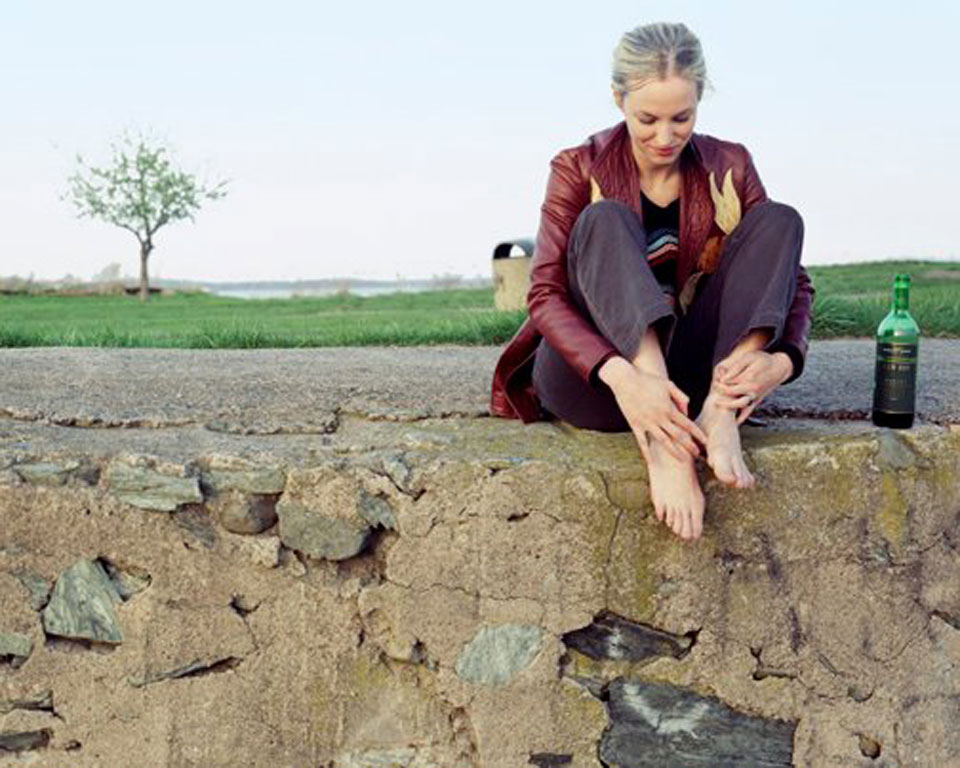
Melanie Willhide
Melanie Willhide grew up in Connecticut, attended the very East Coast schools of RISD and Yale. She moved to Los Angeles in 2004. She brought her sophisticated awareness of art history to this land of illusions and has proceeded to make a very distinct body of photographic work. Her images are rooted in the discourse of photography; it’s concerns with memory, authenticity and narrative. Yet she does not appear to be burdened by that history, her manipulation of surface, content and context serve to create images that are rooted in photographic specificity yet are as mysterious as they are formally rigorous. This interview was conducted via email in January / February 2013.
MAD: What was your conception of photography when you were an undergraduate at RISD? I am interested in how young artists come to their medium and how their ideas of it change when they begin to study it seriously.
MW: Honestly, my relationship with the medium has been fickle at best. Photography and I have a dynamic of classic demand withdrawal: I ignore it and it wants me – I give it attention and it ignores me. But every once and a while we are able to make it work. This was apparent back in my earliest attempt to commit to the medium. I applied to RISD with photographs, but instead of enrolling in the photo department I initially enrolled as a fashion major. While at RISD I tended to mix the two mediums (fashion/fabric arts and photo) in my work. I made photographs to convert into fabric – or used fabric to create objects to photograph. I created patterns for my photographs based on traditional pattern-making techniques, and made wounds out of fabric and photographed them. In these early years I exhibited primarily in an installation format. Eventually I moved over to the photography department. Later in my graduate program at Yale I felt there was little room for anything but the practice of straight photography. So in a way graduate school forced me to really engage with my photography. I used the time to learn the technical craft of lighting and large format. This was the only time I thought of myself as a straight photographer. This period radically focused my work, and since then two concerns have dominated my work: a dedication to making the image disappear in the photograph, and the desire to challenge perceptions of the photograph through digital manipulation.
MAD: I really like your early series Augmented Sixth. I know very little about music theory but isn’t an augmented sixth a dissonant chord? It certainly seems appropriate for the sense of isolation I feel from the images in that series. Also, I was wondering if you were at all influenced by Eileen Cowin’s work from the 1980s? Do you know those kind of ersatz soap opera images in which she sets up her family in friends in melodramatic scenes?
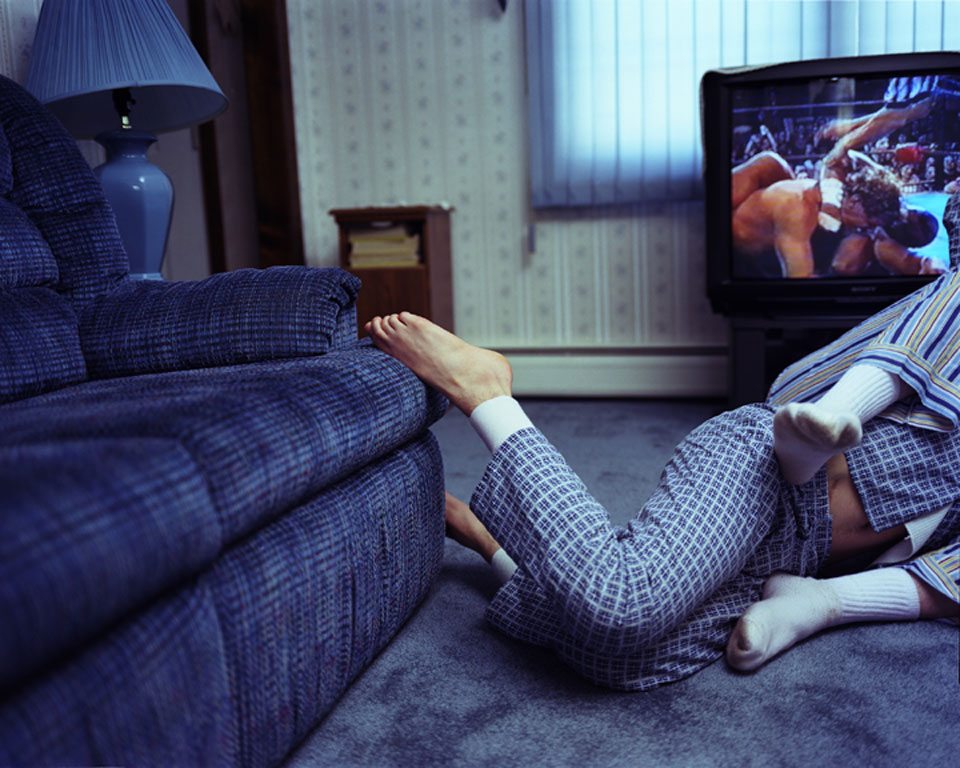
Melanie Willhide, ‘Sleeper Hold’ c-print
20×24″
from ‘Mimic’, 2001
20×24″
from ‘Mimic’, 2001
MAD: The basic gesture of photography is to point at something to say ‘Look at this!’ In other words, the photograph is a window to things in the world. In addition to this, your work points to photography itself. With early projects like Augmented Sixth and Men, ideas of presence, what is inside and outside the frame are important. In later projects such as Sleeping Beauties and Belt of Venus you investigate the materiality of photography and in doing so raise questions about the longing and nostalgia that often fuels our relationship to photographs. Am I misinterpreting or are these issues important to you?
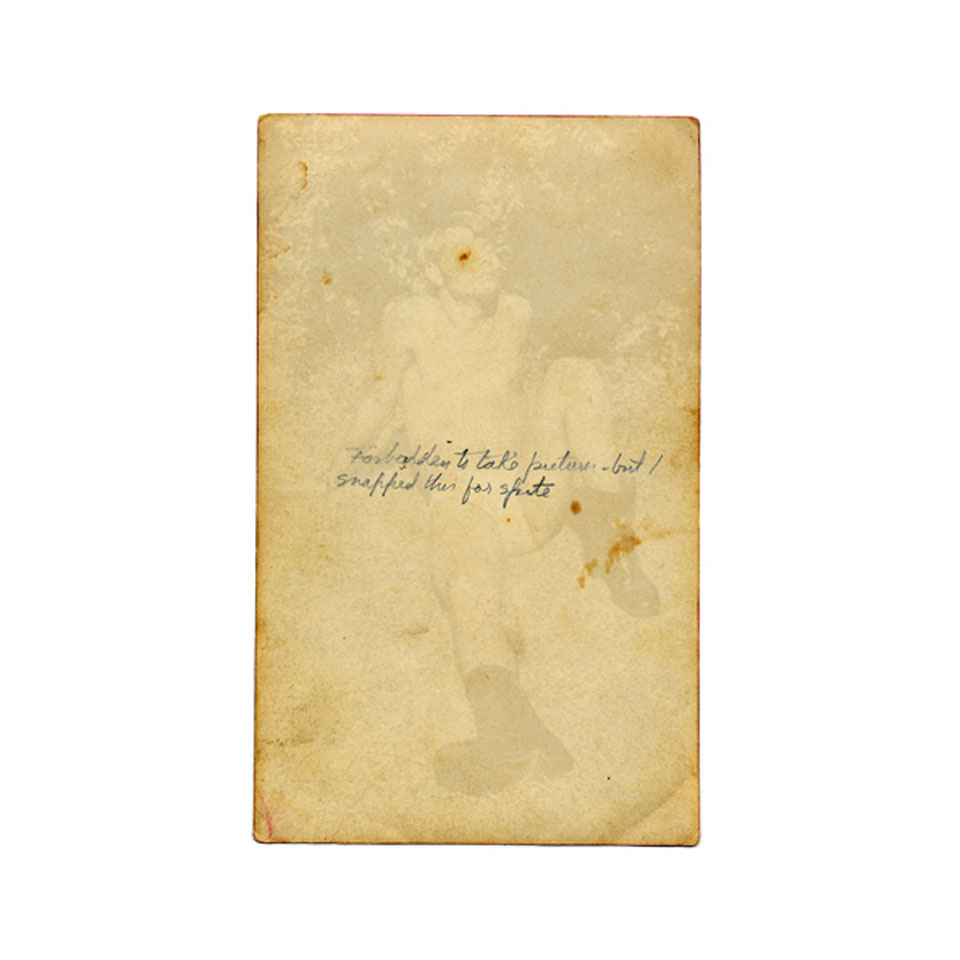
Melanie Willhide, ‘For Spite’
c-print, 24” x 30”
from ‘Sleeping Beauties (The Box Under the Bed)’, 2006
c-print, 24” x 30”
from ‘Sleeping Beauties (The Box Under the Bed)’, 2006
Every part of these images is premeditated, including the front-side imagery and the notes and messages scrawled on the backside. There are hints that these are artificial artifacts in the production. Yet despite the use of recent technology to create something that looks antiquated, viewers are able to tap into the common human experience of the photographic image as memorial to a past love. This is where I think nostalgia can be read into the work. Yet in reality they are devoid of any real experience or real information. They mimic the experience of an image found in a flea market, in which both the image and the text on the backside leave you puzzled as they perhaps fail to define either the subject of the image or the one who owned it. Inspiring these questions is, for me, the most exciting part of working digitally.
In my recent series To Adrian Rodriguez with Love, I simulate (with Photoshop) the language of the corrupted file. With Adrian, the work shifts the concern from the authenticity of an image’s subject to the image as a whole. Here the aesthetic language is more direct; the audience sees the image as well as its illusion (or the result of the failure of Photoshop’s mathematics) at the same time. To use your words – this series show the materiality of the photograph, as well as a nostalgia-inducing illusion.

Melanie Willhide, ‘Beefcake and Betsy’
archival pigment print 28×30″
from To Adrian Rodriquez with Love’, 2011
archival pigment print 28×30″
from To Adrian Rodriquez with Love’, 2011
MAD: Speaking of, your series To Adrian Rodriguez with Love, has received a lot of critical attention, deservedly so. There is an almost mythical story about how the series came about. Do you mind retelling it here and then maybe talk about the moment in which you realized your loss could be an opportunity? Perhaps it is still too early to tell, but did making this work change your trajectory as an artist?
MW: My husband and I bought our first house in Altadena, California—a small town at the base of a state forest, above Pasadena—where cowboys and Cal tech professors live. I left for the day to manage the production of a commissioned piece for another artist in Los Angeles. When I returned to the house, it had been broken into. Items taken: two computers (including mine from my studio), a gold locket, a flat screen TV, and (to the haters) my backup airport.
I spent the next month dealing with a specific set of noteworthy characters at the Altadena Sherriff’s Department: one with a cast painted green with a black happy face drawn boldly on it, as well as some who appeared busy with things like whether or not to take a sweatshirt with them outside. All of them seemed to be eating sandwiches on Wonder bread. In other words, I was met with a host of roadblocks, beginning with the “book” where the details of my robbery had been “written” down having been lost. This continued for close to two months, until the day I stopped at the Sherriff’s station and the green cast-wearing woman told me the Pasadena Police Department had recovered my computer.
When I plugged the computer in I did not have a keyboard, so I was forced to look at the culprit and his girlfriend as a screensaver for a few days, until I could get another keyboard. Once I was able to access the computer I quickly found that my hard drive had been wiped, so I ran recovery software. This process took about 48 hours. When it was completed, my business partner and dear friend Betsy happened to be over. When we opened the files we found that many had been corrupted – family images of my nieces and nephews, wedding photographs, and all of the images I had been working on in two separate series. The first series was based on life saving manuals from the 1950s. These were created with a housing my husband designed so I could take my 4 x 5 camera underwater. They were romantic and played with perception through distortion. The other a series of images, which I loosely called “Suburban Circus,” featured the talents that come out in the last hours of a great party. The work would not edit into exhibition. I had been struggling for some time to edit this work. But as Betsy and I moved the mouse over the recovered images it became clear that the corruption of the files unified the work. It made the work better. So inspired by the effects of the corruption I began to recreate in other photos using Photoshop.
Adrian changed my practice – not only in the appearance of my photos, but also in the very way I thought about images and how they were made. Ultimately, the experience helped me to more clearly identify continued themes in my work over the years and freed me to detach from my work, remain open and ultimately make it better.
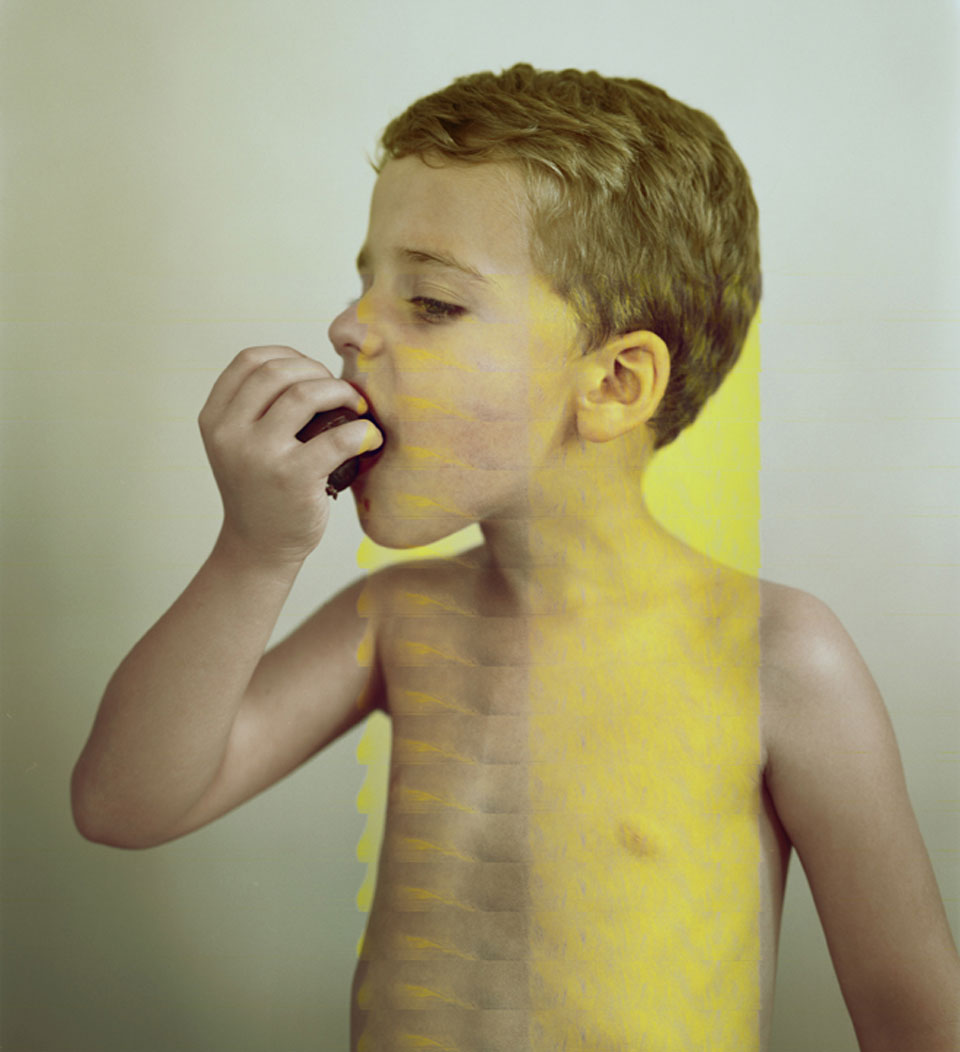
Melanie Willhide, ‘Nate’
archival pigment print, 30×28″
from To Adrian Rodriguez with Love, 2011
archival pigment print, 30×28″
from To Adrian Rodriguez with Love, 2011
MAD: I like what you said earlier about the two concerns that have dominated your work “A dedication to making the image disappear in the photograph and the desire to challenge perception of the photograph through digital manipulation” I have a couple of questions related to that observation. What is the difference between an image and a photograph?
MW: I use the words interchangeably. Though if pressed to draw a distinction, I’d say “image” suggests something was made with consideration. But the word “photograph” implies something less measured, even impulsive in its conception.
MAD: Through most of its history, photography explored what it meant to ‘see’ through the mechanical / optical / chemical processes of photography. Now, many contemporary photographers make work that involves ‘perception’. Do you think this the result of the difference between analog and digital image making? Or, not to be glib but maybe its simply the fact that most photographic artists graduate from art schools and that this is a fundamental formal / philosophical question across all media?
MW: No, I blame art schools for a lot of other things! I do not think the shift in terms, from a “mechanical / optical / chemical” process to one that engages with audience perception, is solely the result of art school speak. I feel it is more related to the culture at large being more self aware and image-savvy than the early practitioners of the medium. Early practitioners who dragged bodies around during the Civil war to create an image of winning were perhaps the first photographers to tap into the idea that photography involves perception. Early audiences equated a photo with reality because it looked so much like what we see with our own eyes. In this way I don’t think the shift is at all related to analog and digital.
I would even argue that all artistic processes have a small period at their beginnings which simply showcases the mechanical / optical / chemical. Eventually, artists explore their perceptions (and those of the audience) through their aesthetics. Just look at the caves of Lascaux – those people must have first marveled at the mark before they decided to draw animals on the walls, right? That said, the push toward viewing photography as perception did have some help from academia, especially with the advances of psychology and feminism. Both introduced the idea that one could see the projection of power and desire.
Additionally, we now know the image to be a selection, and more often than not a modified selection at best. I might even argue that we are beyond the idea of images being modified – that culturally we rarely think about this – in the way girls wearing cutoff jeans so short the pockets stick out don’t think about the feminist movement that won them the choice to wear those shorts.
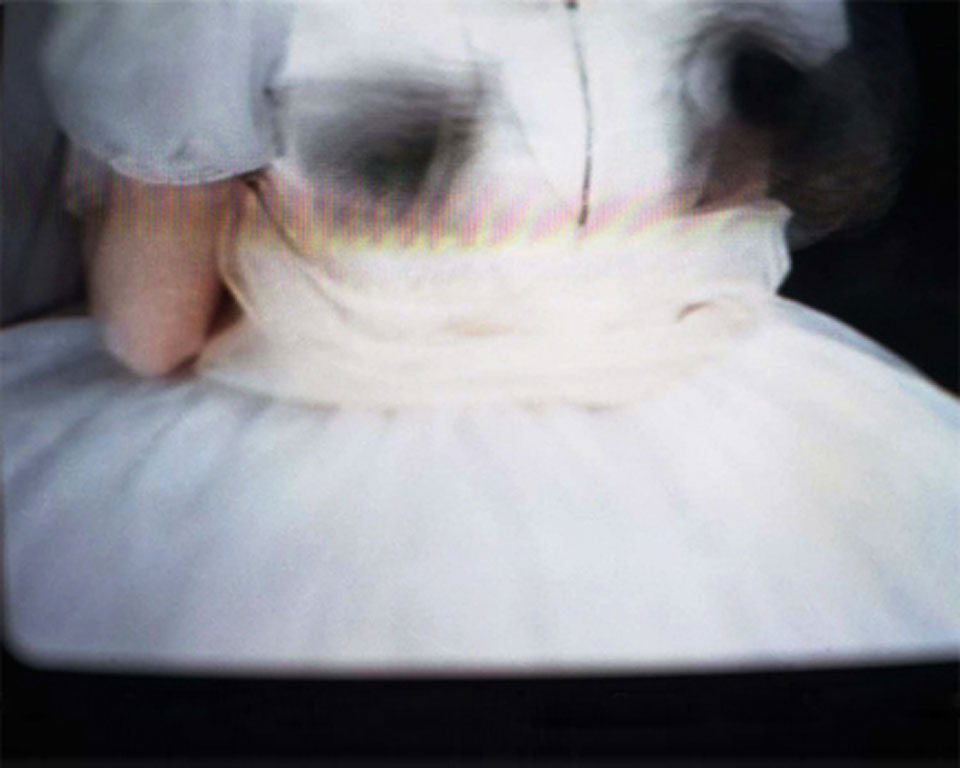
Melanie Willhide, ‘Poison Wings’
5×4″ c-print
from ‘Palindrome’, 2002
5×4″ c-print
from ‘Palindrome’, 2002
MW: I trained for many years to be a ballet dancer. But in my late teens I endured a series of injuries that prevented that dream from being fully realized. I never exhibited this work, nor did I try to. The images are better discussed in terms of a timeline – they were made right out of graduate school. Tired and full of fear for the challenges of beginning a life as an artist, I turned my camera at something predictable – something I knew. I directed a view camera at a television screen playing videos of ballets I had danced: Swan Lake, Nutcracker, Coppelia, Romeo and Juliet, Sleeping Beauty there are a few images from a ballet I always wanted to dance, La Sylphide (a romantic ballet about love and the repercussions of the desire to possess another with the most gorgeous and tragic of endings). I have always staved off anxiety with nostalgia, but I had never made images out of this sort of nostalgia. I initially printed them very small and carried them in my pocket.
MAD: In your pocket? For how long? I like that one might carry one’s art images around the way one might carry pictures of one’s children.
MW: Or more like how a child carries a blanket around for security! I carried them with dedication for 5 months or so – and then only on occasion for the next 5 months after that.
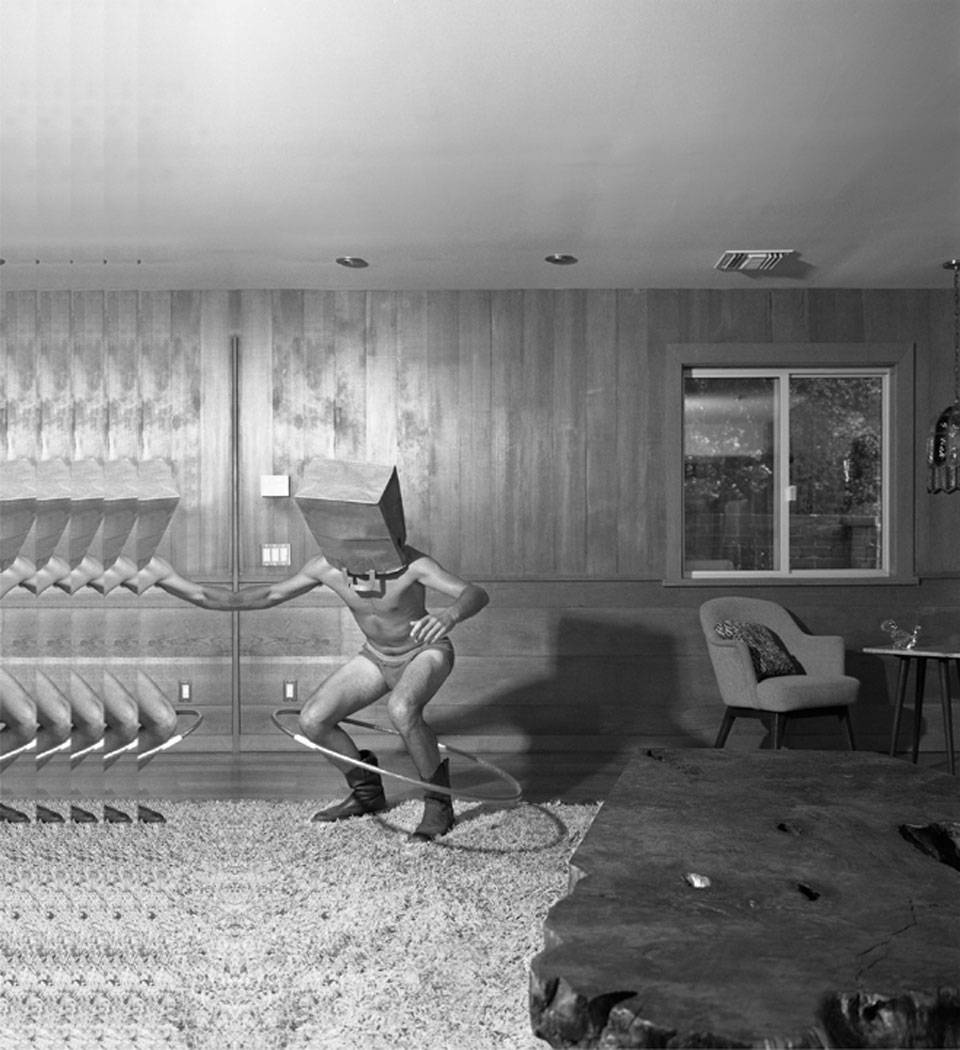
Melanie Willhide, ‘Mike and Hula Hoop’
archival pigment print, 30×28″
from ‘To Adrian Rodriguez with Love’, 2011
archival pigment print, 30×28″
from ‘To Adrian Rodriguez with Love’, 2011
MW: I just want to clarify that I credit Adrian with giving me the idea of recreating the look of the corrupted file in my series. I worked long and hard to create those images using Photoshop. I was very conscious of what corrupted files looked like from the recovered images – and I used that information as I created the images. One of the great advantages of creating seemingly corrupted files was that act of adding an additional layer allowed me to integrate images that otherwise might seem random.
In response to the California binaries portion of the question – I have fallen in love with the body culture here in Los Angeles. It has feed my work since my move here from New York in 2004. At first I found the body culture to be both narrow and extreme in comparison to my east coast roots. Narrow in terms of what is acceptable and desirable (women have expiration dates, and men, who here in sunny southern CA are the new women – have them as well). Extreme in what people do to maintain the illusion (suddenly I had students whose fathers bought them nose and boob jobs as graduation gifts, I found myself at dinners with people who work on their minds with meditation while filling their faces with chemicals to stave off aging, a woman in a bagel shop gave me the stink eye for eating a bagel). It took me 3 weeks to find a model with full-grown pubic hair when I started the box under the bed series. In addition to spray tans, bleaching teeth and the anus, cars with tinted windows, bodies with no hair – I also found my life intersecting with the entertainment industry in odd ways – I had Anna Nicole Smith’s baby daddy in a course I taught and a Back Street boy relaying a message to me that he loved work of mine he had seen in Palm Springs. I thought I was floating around in outer space. I have just gone with it and loved every moment. Perhaps I was very attracted to this culture because of my years dancing – which had its own extreme set of rules regarding how the body should be. And the photographs that have resulted since moving here are like collecting spectacles – specimens – In the way an anthropologist might to study and understand.

Melanie
Willhide
‘Trick #2 and Trick #4, Palm Springs, June’
archival pigment print, 30×28″
from ‘To Adrian Rodriguez with Love’, 2011
‘Trick #2 and Trick #4, Palm Springs, June’
archival pigment print, 30×28″
from ‘To Adrian Rodriguez with Love’, 2011
MW: American life is so much about artifice. Right? For me photography is a type of artificial intimacy. A photograph of a person or an event can be surrogate for the real thing, capable of eliciting emotion similar to what the real person or thing would elicit. It is this willingness to emotionally succumb to the illusion of a photograph that informed the way I created the images for these series. I was making photographs that look like the images made between lovers and friends – those that are intended for the eyes of a single individual. This work is all about artifice – so it absolutely matters, thousand layer phyllo dough of artifice: artificial pictures, artificial subjects, artificial situations, and artificial text. All of this points to the illusion.
For me this is important because photo has long been measured by its ability to represent a reasonable facsimile of reality. It is this old way of measuring that has held the medium of photography hostage – preventing it from being able to play with its inherent property of illusion – say in the way painting is able. I am convinced that if more artists begin to work the medium of photo through programs like Photoshop that the photography would get that added push it needs to transform itself again and be free from the reigns of reality.
MAD: I am curious about your titles – especially in The Belt of Venus series. They are so evocative, for example ‘How Can You Survive Without This Body?’ or ‘Can You See All the Swallows Nests All Along The Walls’ – I like the specificity of the questions and how they create oblique perspectives from which to view the images themselves. Can you talk about how you think about the image / text relationship?
MW: The titles for the images in both Sleeping Beauties (the box under the bed) and The Belt of Venus come from three sources; 1.) A poet and dear friend Jason Labbe (who published a chapbook of poems in 2009 called Dear Photographer) with whom I either collaborated, stole, or drew inspiration from, 2.) Love letters written to me over the course of my lifetime, or 3.) Text taken from the backs of photographs I purchased at flea markets. My rules with titles are they must be 1.) Slightly provocative – either sexually or politically – and 2.) Rather than answering questions – they must be capable of raising questions. I enjoy when titles or text on an images mimics the open-ended read of the image.

Melanie
Willhide,
Can you see all the swallows nests all along the walls?’
9”
x 9” c-print and 23 K gold leaf, from ‘Belt of Venus’, 2007
Tuesday, February 5, 2013
Allyson Strafella | Interview @ The Believer

Allyson Strafella
“Being an artist, if you
can get through it day by day, surviving and paying your bills, the
basic needs, then it’s a pretty expansive life.”
Things that won’t save the world:
Making a drawing
Having a garden
Teaching one’s offspring about honeybees
Making a drawing
Having a garden
Teaching one’s offspring about honeybees
Allyson Strafella can draw with a typewriter, a skill she’s honed over nineteen years of working with a number of Smith Coronas, special transfer papers, and a machinist willing to crack the typewriter open and retool it for her. In some cases, the drawings are made entirely with a colon, a hyphen, or a symbol from Strafella’s own lexicon, punched with extraordinary repetition through colored transfer paper. Some of these gorgeous works have been compared to Ellsworth Kelly’s prints, large geometric blocks of color.
We met one afternoon in her studio, in Hudson, New York, situated on the top level of a two-story barnlike building in the back of the home that she shares with her husband, Max, also an artist (his studio occupies the building’s first floor), and her two children, Miles and Pepper. Between the two buildings are a densely planted garden and a trapezoidal beehive, designed and built by Max.
—Suzanne Snider
*
THE BELIEVER: Tell me about all these typewriters in your studio.
ALLYSON STRAFELLA: I draw only with electric typewriters, which people usually find disappointing. I think they like the idea of me sitting and hammering on a manual. Some are here because I love them as objects. Most are Smith Coronas. The first typewriter I used was my father’s—also a Smith Corona. That one on the white bureau-y thing [pointing] has a sweet personality. Some of the others are here because they’ve been used, or I’m trying to figure out if I can use them. The typewriters I choose not to collect are machines that have a language other than the one I speak. I’ve never been comfortable taking on a typewriter that’s Hindi or Braille or Greek or any other language that is one that I don’t know intimately. I think, also, this is a way for me to further define what my language is, by actually building it and making it and owning it in that way.
Read more @ The Believer
Saturday, February 2, 2013
Photo-Realistic Drawings Trick the Eye at Chelsea Gallery | Joseph Stashkevetch Feat. on DNAinfo.com

 | |
| Joseph Stashkevetch Sonata IV Presentation conte-crayon on rag paper, 60 x 60 inches |
Who needs a camera when you've got a crayon?
An Inwood-based artist's new exhibition at Chelsea's Von Lintel Gallery features amazingly realistic sketches that look just like black-and-white photos.
The images of river-washed pebbles, fog-laden trees, and snowy mountains may seem like the stuff of a "National Geographic" photo shoot, but Joseph Stashkevetch sketches them by hand using a conte crayon — a sort of large pencil — on rag paper.
"People come to the gallery and argue that these can't be drawings," said Stashkevetch, 54. "That's not what they're about for me. Its representation is just a platform to hang other stuff on — it's sort of the vocabulary I'm losing."
Each sketch in the exhibit — called "The More Things Change" — is based on a picture taken during a month-long hike Stashkevetch took in Bhutan six years ago, with each named after "The Rosary Sonatas," a collection of Baroque music that he was listening to at the time.
Done in black and white, the drawings are meant to be more about the contrast of light and shadow than the brightness of any colors.
"Growing up, I was captivated by black-and-white movies," he said. "It's all about what light does — how it wraps around objects."
The drawings are some of the most complex that Stashkevetch has ever done, with details on every part of the frame instead of just in one point, designed to draw in a viewer's eye, he explained.
"I'm more attracted to subjects where it's not something so specific that you focus on," he said. "These are subjects that allow the viewer to come in and find their own place."
Read more @ DNAinfo.com
Saturday, January 19, 2013
JOSEPH STASHKEVETCH | 'The More Things Change' — Opening video

"This latest body of work represents some of Stashkevetch's most complex
drawings to date. The subject matter—thousands of river-washed pebbles
and rocky debris, lacy treetops emerging from the mist and striated
mountains covered in snow—is executed with a painstaking level of intricacy
and detail.
Stashkevetch develops his large-scale black and white compositions
gradually, employing his signature technique. In progressive stages, the
paper's surface is sanded away as the image is built up with conte crayon.
The conte bonds to the paper, and the two materials become one. The
process, both additive and reductive, creates an atmospheric quality in
which light and shadow are in constant play.
Time is palpable in these monumental works. This is owed in part to the
imagery, which alludes to the enduring history and cyclical nature of our
planet. Yet the subject matter itself, the 'what' and the 'where,' becomes
secondary. Standing before the work, one's focus shifts instead to the
patterns embedded in the surface of the paper and the sheer breadth of
Stashkevetch's compositions. Each mark is emblematic of the artist's time as
the drawings break down and become as abstract as time itself. The
imagery, while striking in its beauty, is merely a framework upon which
Stashkevetch masterfully builds his effects.
Born in the United States, Joseph Stashkevetch studied at the Rhode Island
School of Design. The artist's work has been exhibited extensively in the
United States and Europe and appears in numerous public and private
collections, including the Whitney Museum of American Art and the Dallas
Museum of Art. The artist lives and works in New York. This exhibition
marks the artist's fourth solo show with Von Lintel Gallery."


Monday, January 14, 2013
MELANIE WILLHIDE | featured on HUFFINGTON POST
 |
| Melanie Willhide 'Brandi' |
By David Rosenberg
View original post @ SLATE | HUFFINGTON POST
(This post contains nudity.)
For most photographers, having your computer stolen is the stuff of nightmares—it happened to photographer Melanie Willhide, and she knows your next question: “Yes, [the thief] also took our backup drive.” Convinced she would never see the images again, Willhide was shocked when the Pasadena, Calif., police contacted her after they found her computer in the back seat of a car they had pulled over.
“It’s kind of like winning the lottery; it seemed so implausible,” Willhide said.
 |
| Melanie Willhide 'Mike in Hula Hoop, 2010' |
Willhide did what anyone would do: She ran recovery software to try to salvage the corrupted images. Not only did she have personal images on the computer, but two of her long-term projects were also on the drives.
Looking for support, Willhide and her friend and business partner Betsy sat in front of the computer zooming through the recovered images to check out exactly what would be salvageable.
As the images popped up, both women sat in shock.
 |
| Melanie Willhide 'Two Girls' |
“It was completely quiet,” began Willhide. “We’re the sort of
friends where I know exactly what she’s thinking. She doesn’t have to
say anything. And we’re looking through all of these images and I can
sort of feel her body and she’s leaning forward and I said, ‘Oh my God,
do you think it’s better?’ And she’s like ‘well, you know … ’ so I said,
‘I think it’s better.’ And she said, ‘Yes, it’s better.’ ”
The result, To Adrian Rodriguez, With Love,
is Willhide’s ode to the thief who inspired her to work in a new
direction and unwittingly showed her the way to edit together the two
projects for a show—something that had frustrated her up until that
point.
“One series was of domestic circus pictures,” said Willhide. “I’m
always curious about how parties degrade really late at night, so I
tried to make photographs about that stuff.”
The other images were part of a series of underwater shots taken in the swimming pools of celebrity homes in Palm Springs (including Steve McQueen’s house), Calif., using a 4x5 camera and modeling the images after those found in life-saving manuals.
Willhide
decided to replicate some of the corruption found in the recovered
images, teaching herself to do it via Photoshop, splicing images and
making color adjustments. Some of the images she simply tweaked; others
she manipulated from scratch.
But the new project wasn’t just about manipulation.
“It’s really about a life in relation to a machine and sort of dependency I’ve grown to have on this machine to house all these images that are really important and how delicate they are,” said Willhide.
Willhide teaches photography in California at Pasadena City College (she has taught at California State at Fullerton and the School of Visual Arts in New York City) and says she is “of that generation that sort of straddles analog and digital. I still shoot film, I still shoot 4x5, and I still shoot Polaroid.”
And about that Adrian Rodriguez? Willhide was somewhat impressed with some of the images he left on her computer.
“I wish I had him as a student,” Willhide said with a laugh.
The other images were part of a series of underwater shots taken in the swimming pools of celebrity homes in Palm Springs (including Steve McQueen’s house), Calif., using a 4x5 camera and modeling the images after those found in life-saving manuals.
 |
| Melanie Willhide 'Untitled #2 (The Jack Benny House)' |
But the new project wasn’t just about manipulation.
“It’s really about a life in relation to a machine and sort of dependency I’ve grown to have on this machine to house all these images that are really important and how delicate they are,” said Willhide.
Willhide teaches photography in California at Pasadena City College (she has taught at California State at Fullerton and the School of Visual Arts in New York City) and says she is “of that generation that sort of straddles analog and digital. I still shoot film, I still shoot 4x5, and I still shoot Polaroid.”
And about that Adrian Rodriguez? Willhide was somewhat impressed with some of the images he left on her computer.
“I wish I had him as a student,” Willhide said with a laugh.
 |
| Melanie Willhide 'Little Boy Blue' |
SLATE | HUFFINGTON POST
Subscribe to:
Posts (Atom)